
Most private label nasal strip launches don’t fail on product — they stall on paperwork. A marketplace review asks for a test report you don’t have, or customs in your market wants a document the supplier never mentioned. The fix is to treat documentation as a checklist before you commit, not after the container ships.
Below is the checklist serious buyers run through, what we can provide today, and — just as important — the claims a responsible supplier should not make.
For a private label nasal strip program, this is the working set to ask any supplier for:
(This mirrors the working list we maintain for document support.)
Our nasal strip manufacturing holds the following, available on request during qualification:
Certificates are renewed periodically, so rather than publishing versions that go stale, we send the current certificates on request. We can also prepare product and material information for your review up front.


nasal strips and mouth tape, factory-direct – 10M+ pcs/month, samples in 3–7 days. Start with dropshipping or go private label.
Two reasons, both in your interest. First, certificate versions update on a cycle — a PDF posted on a web page is often out of date. Second, the document set you actually need depends on your market. EU and UK listings, US marketplaces, and customs in different countries don’t ask for the same things. So instead of a generic dump, we confirm the exact list for your target market and provide the current versions against it.
Blunt advice, because it protects you: don’t accept “we have all the certificates” from any supplier. Ask which certificates, for which product version, and for which market. A vague answer is a red flag — the specifics are exactly what customs and marketplace reviews check.
This is the part that surprises most new brands: in almost every Western market, a nasal strip is treated as a Class I medical device (regulators call it a nasal dilator), and the registration is usually held by you or your local importer/representative — not the factory. Our job is to hand you the manufacturing-side documents you need to register and to clear customs. Here’s the short version by market:
| Market | Classification | Who registers | What we supply to support it |
|---|---|---|---|
| US (FDA) | Class I, 510(k)-exempt | You register (Establishment Registration + Device Listing) | ISO 13485, ISO 10993 reports, listing info (FDA’s QMSR has been in force since February 2026, aligning with ISO 13485) |
| EU (MDR) | Class I, CE self-declaration | You + an EU Authorized Rep (EC REP); EUDAMED | Technical file inputs, DoC, ISO 10993, risk file, UDI support |
| UK (MHRA) | Class I (confirm for UK) | You + a UK Responsible Person (UK device regulations) | Same technical documents as EU |
| Canada | Class I | Importer holds an MDEL | Documents supporting the importer’s complaint/recall/records/reporting SOPs |
| Australia (TGA) | Class 1 | A local Sponsor registers on the ARTG | TGA accepts our CE DoC or ISO 13485 as evidence |
So the practical question isn’t “do you have certificates” — it’s “which market, and who’s the registrant?” Tell us that, and we’ll map the exact document set to it. The framework above follows the EU Medical Device Regulation structure that most of these regimes borrow from.
A note on claims that applies in every market: nasal strips may be described as offering temporary relief of nasal congestion or breathing comfort — but not as treating sleep apnea (OSA) or any medical condition. Crossing that line can cost a brand its low-risk regulatory status. This isn’t just our caution; it’s how the classification works.
Because the registration usually sits with you, the documents you’re handed should hold up to independent checks. Three that take minutes:
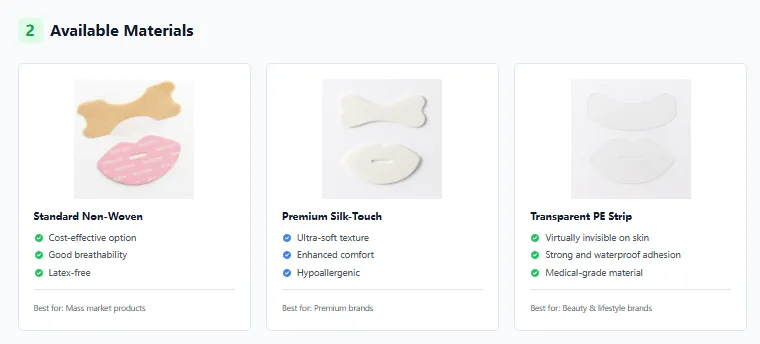
Buyers increasingly ask about material specifics. We can provide a PFAS statement, and material declarations such as BPA-free or latex-free can be confirmed per material version before you rely on them in your listing. We won’t state a material claim until it’s confirmed for the exact version you’re ordering — because a wrong declaration on a listing is your liability, not just ours.

This is the part most pages skip, and it’s the part that protects your brand. For nasal strips — a product in a breathing/sleep-adjacent space — neither we nor you should claim:
What we can support is honest, listing-safe language: breathing comfort, sleep support, sample testing before bulk, lower-risk first orders, and document availability confirmed per market. In compliance-sensitive markets such as the UK and EU, keeping device-style claims off your copy isn’t caution for its own sake — it’s how the listing survives review.
Before any bulk commitment, the useful move is a document gap check: tell us your target market(s) and intended claims, and we’ll return the exact document list for that market and which current certificates we can provide against it.
Request a market-specific document list and we’ll prepare it for your launch. If you’re also comparing manufacturers, our guide to private label nasal strips sourcing covers the capability questions worth asking first. For the full walkthrough, see how to vet a private label nasal strips manufacturer before you commit. For the full launch path in practice, see from sample to first order.
In the US, nasal strips are regulated as Class I 510(k)-exempt devices (the regulator’s term is “nasal dilator”). The brand or US importer typically holds the Establishment Registration and Device Listing — the factory supplies the manufacturing-side documents that support it. FDA’s QMSR, in force since February 2026, aligns US quality-system expectations with ISO 13485.
For a Class I self-declaration under the EU MDR, the manufacturer (usually the brand) declares conformity and works with an EU Authorized Representative, with the record traceable through EUDAMED. The factory provides the technical file inputs, the Declaration of Conformity support, ISO 10993 biocompatibility documentation and the risk file.
Yes — per-product test reports and biocompatibility documentation per ISO 10993 are available on request during qualification, for the product version you’re ordering.
A PFAS statement is available, along with REACH, RoHS and SVHC materials-compliance documentation and MSDS/SDS — current versions provided on request, matched to your product version and target market.
Ask which certification body issued the ISO 13485 certificate and confirm with that body; check that a CE Declaration of Conformity names the manufacturer and the EU Authorized Representative; and for the US, confirm the establishment registration your importer files. A supplier who resists these checks is telling you something.
About the author — Jason W is the founder of Vitazora, a specialist manufacturer of nasal strips and mouth tape for global brands. After six years across export trade and the factory side of skin-safe adhesive manufacturing, she helps DTC and distributor brands get from sample to a safe first order — without the compliance and reorder mistakes that sink new launches.
Note: certifications listed are held by the manufacturing and provided on request; the required document set is confirmed per product version and target market before quoting. Nasal strips are positioned for breathing comfort and are not described as treating any medical condition.
nasal strips and mouth tape, factory-direct – 10M+ pcs/month, samples in 3–7 days. Start with dropshipping or go private label.
